Politics
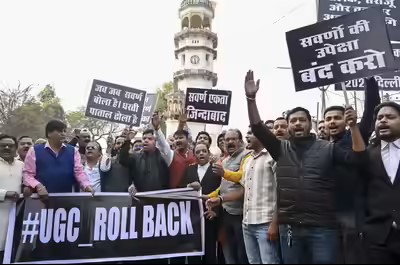
UGC Equity Rules Protests Reveal the Internal Contradictions of Hindutva Victimhood Politics
Manufacturing Majority Insecurity
For over a decade, the RSS-BJP ecosystem has promoted the idea that India’s Hindu majority has been historically deprived of its rightful share of power and resources. Despite constituting nearly 80% of the population and dominating political, economic, and cultural institutions, Hindus have repeatedly been portrayed as vulnerable and under threat.
This narrative has relied on imagined futures of demographic decline, cultural erosion, and economic displacement, often linked to minorities — particularly Muslims. Opposition parties and social justice movements were blamed for allegedly prioritising minority interests at the cost of the “national mainstream.”
Redefining Equity as Appeasement
Affirmative action policies aimed at addressing caste and community-based disadvantage were reframed as “appeasement” rather than correction. Political traditions rooted in Mandal or Dravidian social justice were branded divisive, while religious majoritarianism was normalised as national unity.
Under this framework, inclusion became suspect, and inequality was rendered invisible. Media amplification played a key role in sustaining this inversion, detaching public discourse from ground realities of deprivation faced by Dalits, Adivasis, and Muslims.
Data Versus Narrative
Empirical evidence consistently contradicts the claim of Hindu marginalisation. Studies on wealth distribution show that upper-caste Hindus, though a numerical minority within the Hindu population, control a disproportionately large share of national assets.
Meanwhile, Dalits, Adivasis, and Muslims continue to face severe deficits in education, employment, and asset ownership. These structural gaps remain largely absent from mainstream political conversations shaped by majoritarian grievance.
When Victimhood Turns Inward
The protests against UGC equity rules reveal an unintended consequence of prolonged victimhood politics. Having successfully normalised resentment against minorities, sections of upper-caste Hindu groups are now directing similar hostility toward constitutionally protected rights of Dalits and Adivasis.
With Muslims already politically marginalised, the focus has shifted toward dismantling remaining frameworks of social justice within education and employment.
The BJP’s Balancing Act
The BJP’s attempt to broaden its social base by projecting backward-caste leadership and introducing policies like the Economically Weaker Sections (EWS) quota helped consolidate electoral power. However, it also created tensions with its traditional upper-caste support base.
These contradictions are now surfacing publicly. The same groups that benefited from the politics of grievance are expressing frustration when inclusion threatens their dominance.
Misplaced Anger, Misidentified Targets
Notably, the protests are not directed at governance failures such as unfilled vacancies, recruitment irregularities, exam leaks, or administrative inefficiency. Instead, anger is channelled toward equity rules that symbolically represent redistribution.
This displacement highlights a core belief entrenched within zero-sum politics — the assumption that progress for one group necessarily requires loss for another.
Conclusion
The backlash against UGC equity rules illustrates how Hindutva’s victimhood narrative has reached a point of internal contradiction. What was once used to consolidate power against imagined external threats is now fragmenting along caste lines.
As long as politics remains anchored in the logic of exclusion rather than shared prosperity, such conflicts will continue to surface — reshaping debates on equality, governance, and democracy in India.